
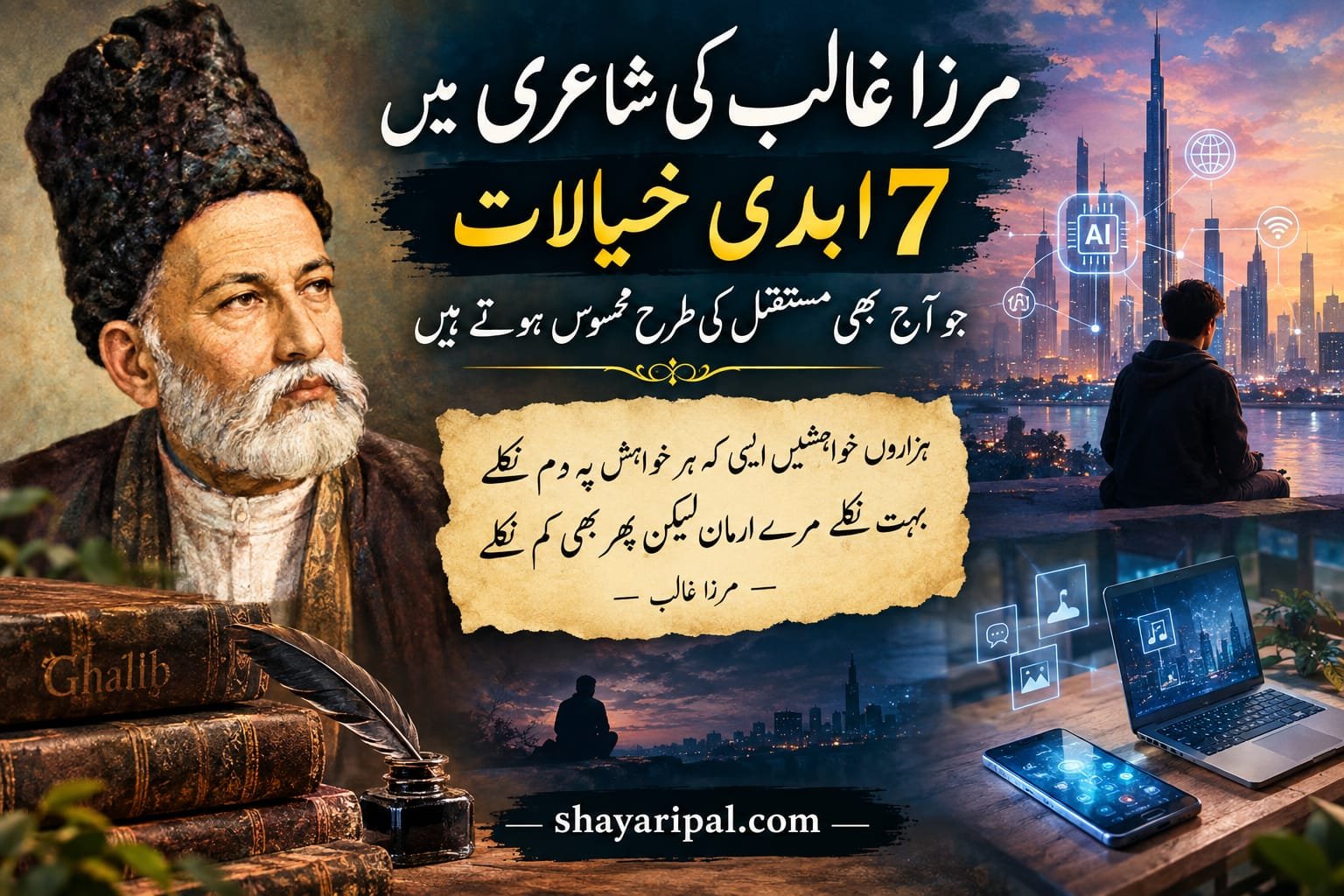
Mirza Ghalib poetry has remained relevant for generations because it explores human emotions, uncertainty, desire, identity, relationships, and the complicated nature of life. Although Mirza Ghalib lived in the 19th century, many ideas found in his poetry can still be connected with the modern world.
Today, people live with artificial intelligence, smartphones, social media, virtual communication, and rapidly changing technology. Yet, human emotions have not changed as quickly as technology. People still experience love, loneliness, hope, disappointment, curiosity, and confusion.
This is where Mirza Ghalib poetry becomes especially interesting. His verses can be read not only as classical Urdu poetry but also as reflections on questions that continue to exist in the digital age.
Ghalib’s famous ghazals include works such as “Hazaron Khwahishen Aisi,” “Koi Umeed Bar Nahin Aati,” “Dil-e-Nadan Tujhe Hua Kya Hai,” and “Bazicha-e-Atfal Hai Duniya Mere Aage.” These works remain among his widely recognized poems.
Why Mirza Ghalib Still Feels Modern
Mirza Ghalib poetry often focuses on questions rather than simple answers. His verses can express doubt, desire, irony, pain, and philosophical curiosity at the same time.
That quality makes his work surprisingly compatible with modern life.
Technology has changed the way people communicate, work, study, and entertain themselves. However, technology has not eliminated emotional questions.
A person can have thousands of online connections and still feel alone. Someone can have access to enormous amounts of information and still struggle to understand their own life.
This is one reason Mirza Ghalib poetry continues to attract new readers.
His writing reminds us that technological progress and emotional progress are not necessarily the same thing.
1. Human Desire in a Digital World
One of the strongest themes in Mirza Ghalib poetry is desire.
People have always wanted something more. In the modern world, this desire has taken new forms. People may want more followers, better careers, newer devices, financial success, travel experiences, or recognition.
Yet achieving one desire often creates another.
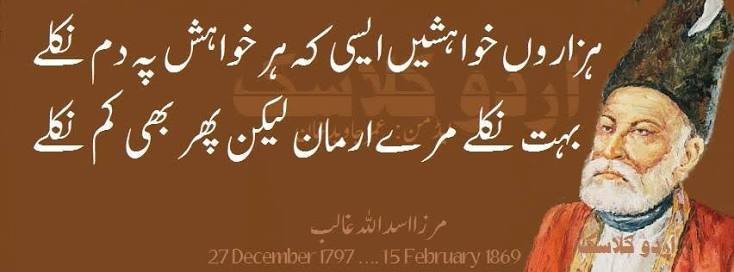
Ghalib expressed this endless nature of human wishes beautifully:
ہزاروں خواہشیں ایسی کہ ہر خواہش پہ دم نکلے
بہت نکلے مرے ارمان لیکن پھر بھی کم نکلے
This famous couplet comes from Ghalib’s well-known ghazal.
The idea feels remarkably modern.
Social media can continuously show people new lifestyles and new goals. Online shopping can provide endless choices. Technology can make new products available every year.
Still, satisfaction does not automatically increase.
This aspect of Mirza Ghalib poetry can therefore be connected with the psychology of the modern digital consumer.
The future may give humans more choices than ever, but the basic question may remain the same: how much is actually enough?
2. Technology Cannot Remove Uncertainty

Modern technology is often designed to predict what might happen next.
Artificial intelligence can analyze data. Weather systems can provide forecasts. Algorithms can recommend products, music, films, and even relationships.
However, uncertainty remains part of human life.
Ghalib repeatedly explored uncertainty and disappointment in his poetry. One famous example is:
کوئی امید بر نہیں آتی
کوئی صورت نظر نہیں آتی
This couplet reflects a feeling of uncertainty and the absence of an obvious solution.
The emotional situation is very different from modern technology, but the underlying human experience remains recognizable.
This is another reason Mirza Ghalib poetry can be viewed from a futuristic perspective.
Even if future machines become extremely advanced, humans may still face situations where there is no clear answer.
3. The Future of Human Emotions
Artificial intelligence can generate text, create images, compose music, and imitate different writing styles. Yet questions about genuine human emotion remain important.
Can a machine truly experience love?
Can an algorithm understand heartbreak?
Can technology completely reproduce human imagination?
These questions make Mirza Ghalib poetry especially interesting in the age of AI.
Ghalib often explored the relationship between the mind and the heart. His famous line asks:
دلِ ناداں تجھے ہوا کیا ہے
آخر اس درد کی دوا کیا ہے
The verse presents the heart almost as something that cannot be easily understood or controlled.
In a future dominated by intelligent machines, this idea may become even more relevant.
Technology can analyze patterns in human behavior, but understanding the full depth of human emotion remains a much more complicated challenge.
4. Ghalib and the Question of Identity
Identity is another theme that can be connected with the modern world.
Today, people often maintain multiple identities online. A person may have a professional profile, a personal account, a gaming identity, and different versions of themselves across social platforms.
This creates an interesting question: which version represents the real person?
Mirza Ghalib poetry often examines the complicated relationship between the individual and the world around him.
His poetry does not always provide a straightforward answer. Instead, it encourages readers to think.
That quality makes Ghalib’s work useful when discussing future questions about digital identity.
As virtual reality and digital environments become more advanced, people may spend more time creating alternative versions of themselves.
The question of identity could therefore become even more important.
5. Loneliness in the Connected World
Modern technology has made communication easier than ever.
A message can travel across the world within seconds. Video calls allow people to see one another from different countries. Social platforms allow millions of people to communicate.
Yet loneliness has not disappeared.
This contradiction makes Mirza Ghalib poetry surprisingly relevant to today’s connected world.
Ghalib understood emotional distance even when communication depended on letters and physical travel.
His poetry frequently explores separation, longing, and emotional isolation.
One of his famous ideas appears in the verse:
رہیے اب ایسی جگہ چل کر جہاں کوئی نہ ہو
ہم سخن کوئی نہ ہو اور ہم زباں کوئی نہ ہو
The couplet imagines a place away from others, emphasizing the complexity of human relationships.
In the future, people may become even more connected digitally while still searching for genuine emotional connection.
That contrast gives Mirza Ghalib poetry a fascinating place in conversations about future society.
6. Curiosity and the Search for Meaning
Another important quality of Ghalib’s poetry is intellectual curiosity.
He often questions life instead of accepting everything as simple or obvious.
This attitude is valuable in the modern research-driven world.
Scientists ask questions about space, biology, artificial intelligence, quantum physics, and consciousness. Technology develops because people refuse to stop asking questions.
In this sense, Mirza Ghalib poetry can inspire a culture of curiosity.
Poetry and science are different fields, but both can begin with a question.
A scientist may ask how the universe works.
A poet may ask why humans feel the way they do.
Both questions can lead toward deeper understanding.
This is one reason classical poetry can still have value in a highly technological future.
7. A World That Keeps Changing
Ghalib lived during a period of major social and political change. His writing reflects a world in transition.
Modern society is also changing rapidly.
Artificial intelligence, robotics, biotechnology, virtual reality, and automation are transforming daily life.
The technology of tomorrow may look completely different from today’s technology.
Yet Mirza Ghalib poetry reminds readers that change is not only technological. Human beings also have to adapt emotionally and intellectually.
One of Ghalib’s famous philosophical lines is:
بازیچۂ اطفال ہے دنیا مرے آگے
ہوتا ہے شب و روز تماشا مرے آگے
This verse presents the world as a constantly changing spectacle. It remains one of Ghalib’s widely recognized couplets.
Read from a modern perspective, the imagery can feel surprisingly compatible with a rapidly changing digital world.
Every day brings new platforms, inventions, trends, and discoveries.
The world continues to change, while people continue to observe, experience, and interpret it.
Why Ghalib’s Poetry Can Inspire Future Generations
The strength of Mirza Ghalib poetry is not limited to historical importance.
His work continues to raise questions about desire, identity, uncertainty, love, loneliness, and human nature.
These subjects do not belong to one century.
A future society may have advanced robots, autonomous vehicles, artificial intelligence, virtual worlds, and technologies that we cannot yet imagine.
Still, humans may continue to ask similar questions.
Who am I?
What do I really want?
Why do I love?
Why do I suffer?
What makes life meaningful?
These questions give Mirza Ghalib poetry a timeless quality.
The technology surrounding humanity may change dramatically, but the emotional questions inside humanity may remain surprisingly familiar.
Frequently Asked Questions
Why is Mirza Ghalib poetry still popular?
Mirza Ghalib poetry remains popular because it explores universal themes such as love, desire, uncertainty, identity, and human emotions.
What makes Ghalib’s poetry feel futuristic?
Ghalib’s poetry discusses human questions that can still be connected with modern subjects such as artificial intelligence, digital identity, technology, and loneliness.
Which Ghalib poem is especially famous?
“Hazaron Khwahishen Aisi” is among Ghalib’s most recognized ghazals, along with “Koi Umeed Bar Nahin Aati” and “Dil-e-Nadan Tujhe Hua Kya Hai.”
Can Ghalib’s poetry be connected with artificial intelligence?
Yes. Mirza Ghalib poetry can be discussed alongside AI when exploring questions about human emotion, consciousness, identity, creativity, and the difference between human and machine intelligence.
What is special about Ghalib’s writing?
Ghalib often combines emotion, philosophy, irony, and intellectual questioning, allowing his poetry to be interpreted from different perspectives.
Why should young readers read Ghalib today?
Young readers can discover ideas about emotions, human nature, uncertainty, and self-reflection that remain relevant despite changes in technology and society.
Conclusion
Mirza Ghalib poetry proves that great literature does not become outdated simply because technology changes.
Ghalib lived in a very different world, yet his questions about human desire, uncertainty, loneliness, identity, and emotion remain recognizable today.
The future may bring artificial intelligence, virtual worlds, advanced robots, and technologies that completely transform everyday life. But the human mind and heart may continue to face many of the same questions.
That is what makes Ghalib’s poetry so interesting for a futuristic discussion.
His verses can be read as classical Urdu literature, philosophical reflections, or windows into the timeless complexity of human nature.
Perhaps the most futuristic lesson of Mirza Ghalib poetry is also the simplest: technology can change the world around us, but understanding ourselves may always remain one of humanity’s greatest challenges.