
Artificial intelligence is becoming an important part of modern life. It is being used for writing, education, science, business, design, communication, and many other activities. As AI becomes more capable, an important question is also being raised: how can humans remain creative, independent, and purposeful in a world filled with intelligent machines?
This question can be explored through the poetry and philosophy of Allama Muhammad Iqbal. Iqbal lived long before modern artificial intelligence was developed, so his poetry should not be described as a prediction of AI. However, many of his ideas about human potential, selfhood, action, freedom, creativity, and ambition can be connected with today’s technological world.
The 7 Powerful Iqbal Poetry Lessons for AI offer a modern way to think about these ideas. Each lesson can be understood as a reminder that technology should support human development rather than replace human purpose.
Table of Contents
- What Are the 7 Powerful Iqbal Poetry Lessons for AI?
- Lesson 1: Build a Strong Human Identity
- Lesson 2: Do Not Become Dependent on Machines
- Lesson 3: Protect Human Creativity
- Lesson 4: Turn Knowledge Into Action
- Lesson 5: Keep Exploring New Possibilities
- Lesson 6: Protect Independent Thinking
- Lesson 7: Keep Human Purpose at the Center
- Iqbal Poetry and the Future of AI
- How Students Can Apply These Lessons
- How Writers and Creators Can Apply Them
- Frequently Asked Questions
- Conclusion
What Are the 7 Powerful Iqbal Poetry Lessons for AI?
The 7 Powerful Iqbal Poetry Lessons for AI are based on major ideas found in Iqbal’s poetry. These ideas include Khudi, personal development, independent thought, creativity, action, ambition, and purposeful living.
Iqbal’s poetry often encouraged people to recognize their inner strength. His famous concept of Khudi can be viewed today as a reminder that humans should maintain their individuality even when powerful technologies are available.
His famous Shaheen also represents ambition, independence, and the courage to move beyond ordinary limits.
Therefore, the 7 Powerful Iqbal Poetry Lessons for AI are not presented as direct statements about artificial intelligence. They are modern interpretations of philosophical ideas that can be considered in the context of today’s technology.
Lesson 1: Build a Strong Human Identity
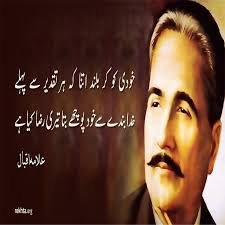
The first of the 7 Powerful Iqbal Poetry Lessons for AI is about human identity.
AI can now write paragraphs, generate images, summarize books, translate languages, and provide answers within seconds. Because of this, people may sometimes wonder what makes human thinking special.
Iqbal’s concept of Khudi provides an interesting perspective. Khudi is commonly associated with selfhood, self-awareness, confidence, and personal development.
Iqbal wrote:
“خودی کو کر بلند اتنا کہ ہر تقدیر سے پہلے
خدا بندے سے خود پوچھے، بتا تیری رضا کیا ہے”
This famous verse presents the idea of developing the self to a higher level.
In the AI age, this can be interpreted as a reminder that people should not allow technology to define their identity. A person can use AI for assistance while still developing personal opinions, skills, values, and goals.
A machine can generate an answer, but a human being still needs to decide whether that answer is meaningful.
Thus, the 7 Powerful Iqbal Poetry Lessons for AI begin with the importance of protecting human identity.
Lesson 2: Do Not Become Dependent on Machines
The second lesson in the 7 Powerful Iqbal Poetry Lessons for AI is about independence.
Technology can make many tasks easier. However, convenience can sometimes create dependence. If every decision is handed over to a machine, personal problem-solving skills may gradually become weaker.
Iqbal’s Shaheen is often presented as a symbol of freedom and independence. In his poetry, the bird is not associated with a passive life. Instead, it represents movement, courage, and high ambition.
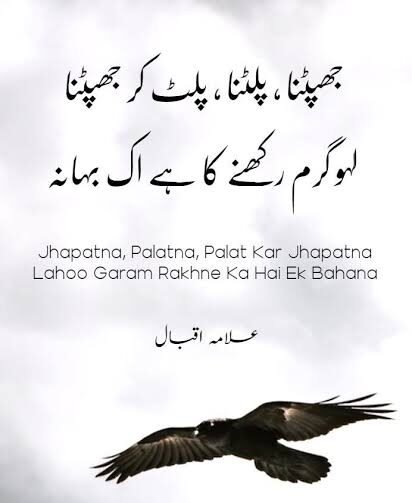
Iqbal writes:
“جھپٹنا، پلٹنا، پلٹ کر جھپٹنا”
The Shaheen’s energetic movement can be connected with the modern need to remain active even when technology is doing more work for us.
AI can be used as a helpful assistant. However, human effort should not disappear completely.
Students should still learn. Writers should still think. Researchers should still question evidence. Professionals should still make important decisions carefully.
This is another reason why the 7 Powerful Iqbal Poetry Lessons for AI remain interesting for the modern digital age.
Lesson 3: Protect Human Creativity
The third lesson among the 7 Powerful Iqbal Poetry Lessons for AI focuses on creativity.
AI-generated content has developed rapidly. Images, articles, music, videos, and designs can now be created with the help of artificial intelligence.
This development can be useful, but creativity should not become completely automated.
Iqbal’s poetry encourages people to look beyond what is already known. His famous poem contains the lines:
“ستاروں سے آگے جہاں اور بھی ہیں
ابھی عشق کے امتحاں اور بھی ہیں”
The idea of worlds existing beyond the stars can be interpreted as a powerful image of imagination and possibility.
In today’s world, AI can help people explore ideas faster. However, the human imagination can still provide the purpose behind those ideas.
A designer may use AI to explore several concepts, but personal taste is still involved. A writer may use AI for brainstorming, but personal experience can make the final story meaningful.
Therefore, the 7 Powerful Iqbal Poetry Lessons for AI encourage people to use technology without abandoning original creativity.
Lesson 4: Turn Knowledge Into Action
The fourth lesson in the 7 Powerful Iqbal Poetry Lessons for AI is about action.
AI can provide huge amounts of information. A question can be answered almost instantly. Research can be summarized, and complex subjects can be explained in simple language.
However, information is not the same as achievement.

Iqbal often emphasized action and effort. One of his well-known verses says:
“عمل سے زندگی بنتی ہے جنت بھی جہنم بھی”
The verse connects human life with action.
In the modern world, this idea can be applied to AI use. A person may use AI to learn about a new skill, but the skill still needs to be practiced.
A student may receive an explanation from AI, but the knowledge becomes stronger when it is applied.
A business owner may receive ideas from an AI system, but real progress requires action.
The 7 Powerful Iqbal Poetry Lessons for AI therefore suggest that technology should help people move from knowledge toward meaningful action.
Lesson 5: Keep Exploring New Possibilities
The fifth lesson in the 7 Powerful Iqbal Poetry Lessons for AI is about ambition and exploration.
AI is already opening new possibilities in science, medicine, education, engineering, and creative work. However, technological progress should not mean that humans stop imagining new possibilities.
Iqbal frequently used the imagery of flight and the sky to express ambition.
He wrote:
“تو شاہیں ہے پرواز ہے کام تیرا
ترے سامنے آسماں اور بھی ہیں”
The Shaheen is shown looking toward wider possibilities rather than remaining within a narrow boundary.
This idea can be connected with modern innovation. People can use AI to explore problems that were previously difficult to solve.
At the same time, ambition should be balanced with responsibility. New technology should be developed thoughtfully, and its effects on people and society should be considered.
The 7 Powerful Iqbal Poetry Lessons for AI therefore connect ambition with responsible exploration.
Lesson 6: Protect Independent Thinking
The sixth lesson among the 7 Powerful Iqbal Poetry Lessons for AI is about independent thought.
AI can influence how information is received. Search systems, recommendation systems, and AI assistants can all affect what people see and read.
This makes critical thinking increasingly important.
Iqbal’s poetry contains many reflections on knowledge, reason, thought, and the search for deeper understanding.
He wrote:
“خرد کے پاس خبر کے سوا کچھ اور نہیں
ترا علاج نظر کے سوا کچھ اور نہیں”
This verse can be interpreted as distinguishing information from deeper vision.
The modern connection is important. AI may provide information, but information should still be examined.
People can ask:
- Is the information accurate?
- What evidence supports it?
- Could the answer contain an error?
- Are other viewpoints available?
- What assumptions were made?
The 7 Powerful Iqbal Poetry Lessons for AI remind modern users that receiving information quickly should not mean accepting everything without thought.
Lesson 7: Keep Human Purpose at the Center
The final lesson in the 7 Powerful Iqbal Poetry Lessons for AI is about purpose.
AI systems can become increasingly powerful. They may perform more tasks and solve increasingly complex problems. However, technology itself cannot decide what human beings should value.
That question remains connected with human judgment.
Iqbal’s poetry frequently focuses on purpose, self-development, courage, and meaningful living.
His concept of Khudi can be connected with the idea that a person should not simply exist but should develop a meaningful direction.
This becomes especially important in an AI-driven future.
Technology may tell us how to perform a task. It may even suggest different solutions. However, humans still need to ask why the task matters.
The 7 Powerful Iqbal Poetry Lessons for AI therefore place human purpose at the center of technological progress.
Iqbal Poetry and the Future of AI
The 7 Powerful Iqbal Poetry Lessons for AI provide an interesting bridge between classical poetry and modern technology.
Iqbal did not write about chatbots, machine learning, neural networks, or generative AI. His world was very different from ours.
Yet the human questions discussed in his poetry remain relevant.
What makes a person strong?
How should knowledge be used?
Why is action important?
How can creativity be protected?
Why should people remain independent?
How can ambition be developed?
What gives human life purpose?
These questions can still be asked in the AI age.
For this reason, Iqbal’s poetry can be read alongside modern discussions about technology without claiming that he directly predicted artificial intelligence.
How Students Can Apply These Lessons
The 7 Powerful Iqbal Poetry Lessons for AI can be especially useful for students.
AI can be used to explain difficult subjects, generate practice questions, organize research, improve grammar, and provide learning support.
However, students can also use these tools in a way that protects independent learning.
For example, a student can first attempt a problem independently and then use AI to identify mistakes.
A difficult concept can be explained by AI, but the student can then explain it again using personal understanding.
Research ideas can be generated with AI, while the final argument can be developed through independent study.
This approach allows technology to support education without replacing the learning process.
Iqbal’s emphasis on self-development makes this approach especially meaningful.
How Writers and Creators Can Apply These Lessons
The 7 Powerful Iqbal Poetry Lessons for AI are also relevant to writers, artists, and other creators.
AI can be used for brainstorming, editing, research organization, translation, and early creative exploration.
However, a creator’s personal voice should remain important.
A writer may ask AI for ten story ideas but choose one based on personal experience.
An artist may use AI to explore visual possibilities while still deciding what message the final work should communicate.
A poet may use technology for research while keeping personal emotion and expression at the center.
Iqbal’s own poetry demonstrates the importance of a recognizable voice and strong ideas.
Therefore, AI can be treated as a creative tool rather than the complete source of creativity.
Why These Lessons Matter for the Future
The 7 Powerful Iqbal Poetry Lessons for AI become more relevant as AI systems become increasingly common.
The future will not only be about smarter machines. It will also be about how humans respond to those machines.
If technology becomes powerful, human responsibility will become important as well.
If information becomes abundant, critical thinking will become more valuable.
If content becomes easier to produce, originality may become more meaningful.
If automation increases, purpose and personal development may deserve greater attention.
Iqbal’s poetry does not provide technical instructions for artificial intelligence. Instead, it can provide philosophical questions that encourage people to think about the human side of technological progress.
Frequently Asked Questions
1. What are the 7 Powerful Iqbal Poetry Lessons for AI?
The 7 Powerful Iqbal Poetry Lessons for AI are based on seven themes: human identity, independence, creativity, action, exploration, independent thinking, and human purpose.
2. Did Iqbal actually write about AI?
No. Allama Iqbal died in 1938, before modern artificial intelligence was developed. The connection between his poetry and AI is a modern philosophical interpretation.
3. What does Khudi mean in Iqbal’s poetry?
Khudi is commonly discussed as a concept involving selfhood, self-awareness, personal development, confidence, and the strengthening of the individual.
4. Why is the Shaheen important in Iqbal’s poetry?
The Shaheen is an important symbol associated with freedom, courage, ambition, and high aspiration in Iqbal’s poetry.
5. Can Iqbal’s poetry help people understand AI?
It can provide philosophical ideas for thinking about the human side of AI, especially questions about identity, creativity, knowledge, action, and purpose.
6. Should people depend completely on AI?
AI can be useful for assistance, but independent thinking and personal judgment remain important, particularly for education, research, creativity, and important decisions.
7. What is the main message of these seven lessons?
The central message is that technological progress should be accompanied by human development. AI can increase human capabilities, but human values and purpose still matter.
Conclusion
The 7 Powerful Iqbal Poetry Lessons for AI offer a fascinating way to connect Allama Iqbal’s timeless ideas with today’s rapidly changing technological world.
Iqbal did not predict modern artificial intelligence. Nevertheless, his poetry explored questions that remain important today. His ideas about Khudi can encourage people to protect their identity. His Shaheen can represent ambition and independence. His poetry about action can remind people to use knowledge rather than simply collect it.
At the same time, his vision of wider horizons can inspire creativity and exploration, while his emphasis on thought can encourage people to question information instead of accepting it automatically.
The 7 Powerful Iqbal Poetry Lessons for AI ultimately suggest that the future should not be viewed only through the power of machines.
AI may become faster and more capable, but humans will still need creativity, judgment, values, courage, and purpose.
That is where Iqbal’s poetry can continue to provide an interesting source of reflection for the digital age.