

Urdu poetry has produced many remarkable poets, but only a few have created a voice that feels completely different from traditional romantic poetry. Jaun Elia Shayari is remembered for its mixture of love, loneliness, disappointment, philosophy, memory, and emotional honesty.
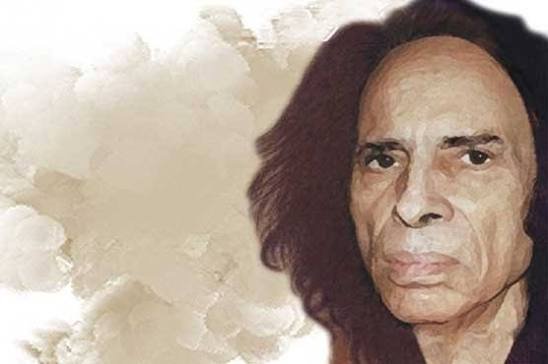
Jaun Elia was born in 1931 in Amroha, India, and later moved to Pakistan. He became known not only as a poet but also as a scholar, writer, and intellectual. His first major poetry collection, Shayad, was published in 1991.
Unlike poetry that presents love as something perfect and beautiful, Jaun Elia Shayari often explores the difficult side of relationships. Separation, regret, uncertainty, and emotional conflict frequently become central subjects.
His poetry can sometimes feel like a conversation with oneself. The speaker may be confident in one moment and deeply uncertain in the next.
That contradiction is one reason his work continues to attract readers.
1. Love Is Not Always Presented as Happiness
One of the strongest ideas in Jaun Elia Shayari is that love can contain both happiness and pain.
Traditional romantic poetry often focuses on beauty, meetings, admiration, and longing. Jaun Elia approached these subjects differently. His poetry frequently explores what happens when affection becomes complicated.
Love can create hope, but it can also create uncertainty.
A person may care deeply about someone while knowing that the relationship may not have a future. This emotional contradiction appears repeatedly in his poetic themes.
Because of this, Jaun Elia Shayari can feel realistic to readers who have experienced complicated relationships.
Instead of presenting a perfect romantic world, his work often explores emotional imperfections.
Poetry Inspired by This Theme
Love stayed in the heart, but peace never stayed.
This original two-line poetic idea reflects the emotional contradiction often associated with Jaun’s poetry. Love is shown as something powerful but not necessarily peaceful.

The deeper message is that affection can remain even when circumstances have changed.
2. Loneliness Becomes a Central Character
Loneliness is another major theme associated with Jaun Elia Shayari.
In many poems, loneliness is not simply about being physically alone. It can describe an internal feeling of separation from other people.
A person can sit among friends and still feel completely disconnected.
This idea makes his poetry particularly relatable to modern readers. Technology has made communication easier, yet emotional loneliness remains a common human experience.
Jaun’s writing often turns this feeling into poetry.
His poetic speaker may remember someone, question the past, or think about a relationship that has ended. However, the deeper subject is often the individual’s relationship with their own thoughts.
Therefore, Jaun Elia Shayari does not simply describe loneliness. It explores how loneliness can influence memory, relationships, and identity.
Poetry Inspired by This Theme
The room was full of people, yet my silence remained alone.
I searched for myself in every familiar face.
These original lines capture the idea of emotional loneliness. Being surrounded by people does not always remove the feeling of isolation.
This is one reason Jaun’s emotional themes continue to connect with modern readers.
3. His Poetry Questions Everything
Another unusual quality of Jaun Elia Shayari is its questioning nature.
The poet does not always provide clear answers.
Instead, questions are allowed to remain unresolved.
Why did a relationship fail? Why does someone remember a person who caused pain? Why do people repeat their mistakes? Why does the past continue influencing the present?
These questions give Jaun Elia Shayari a philosophical dimension.
His poetry can therefore be read at different levels. One reader may see a poem as a story about lost love, while another may interpret it as an exploration of human nature.
This flexibility is an important part of his appeal.
Rather than explaining everything directly, his poetry often leaves space for the reader to think.
Poetry Inspired by This Theme
I asked the heart for an answer; it returned another question.
This original line represents the questioning nature of his poetic themes.
Sometimes the purpose of poetry is not to solve a problem. Instead, it is to make the reader think more deeply about the problem.
4. Pain Is Expressed Without Pretending to Be Perfect
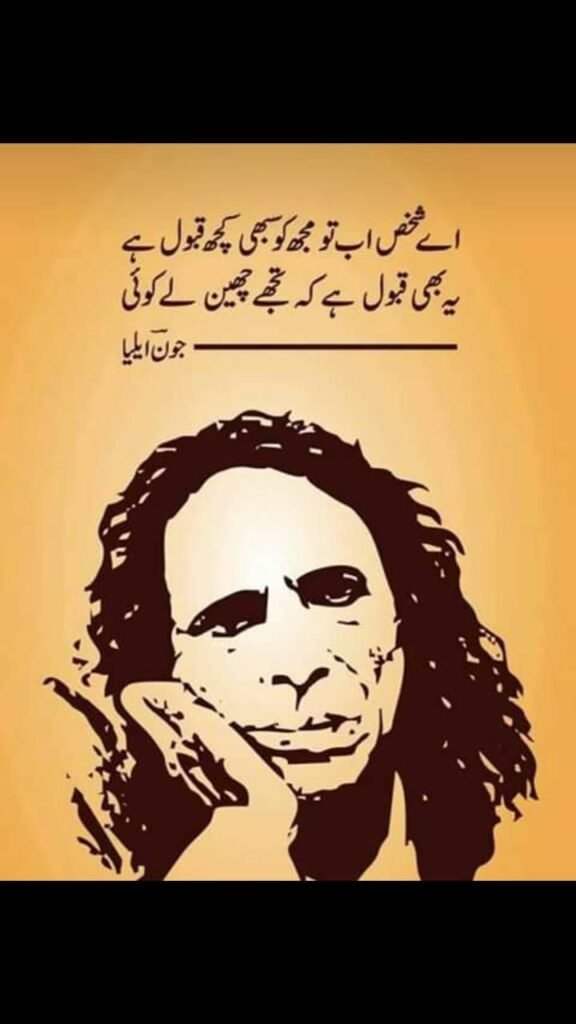
Many poets try to make sadness beautiful. Jaun Elia often presented sadness in a more uncomfortable and honest way.
This difference can be noticed throughout Jaun Elia Shayari.
His poetic voice can sound frustrated, disappointed, sarcastic, or emotionally exhausted. The speaker does not always appear calm or heroic.
Instead, vulnerability becomes part of the writing.
This creates an unusual form of emotional honesty.
People often hide disappointment because they believe they should appear strong. Jaun’s poetry frequently moves in the opposite direction.
The emotional struggle itself becomes the subject.
As a result, Jaun Elia Shayari can feel less like a polished romantic performance and more like a private conversation.
Poetry Inspired by This Theme
I smiled so no one would ask,
How much the silence had already broken me.
These original lines express the contrast between an outward appearance and an inner emotional struggle.
That contrast is a recurring reason readers find Jaun’s themes emotionally powerful.
5. His Language Can Feel Like Everyday Conversation
Another reason readers find Jaun Elia Shayari accessible is the conversational quality of his writing.
Classical Urdu poetry can sometimes use highly formal vocabulary and complex imagery. Jaun Elia had deep knowledge of Urdu and Persian literary traditions, but his poetic voice could also feel direct and personal.
The language can sound like someone thinking aloud.
This quality allows Jaun Elia Shayari to communicate difficult emotions without always requiring complicated interpretation.
However, simple expression does not necessarily mean simple ideas.
A short thought can contain questions about identity, relationships, mortality, memory, or human behavior.
This combination of accessible language and deeper meaning is one of the distinctive features of his literary appeal.
Poetry Inspired by This Theme
I had so much to say,
Yet silence became the easiest sentence.
These original lines use simple language to express a deeper emotional idea.
This is the type of direct emotional communication that many readers appreciate in modern Urdu poetry.
6. His Poetry Contains Contradictions
Perhaps one of the most fascinating elements of Jaun Elia Shayari is contradiction.
The poet may express love and rejection almost simultaneously.
He may want someone close while also recognizing that separation is inevitable.
He may criticize the world while examining his own role within it.
These contradictions make the poetry feel human.
People rarely experience emotions in perfectly organized categories. Love can exist alongside anger. Memories can contain happiness and pain. A person can miss someone while knowing that returning to the relationship may not be possible.
Jaun Elia Shayari captures this emotional complexity.
Instead of simplifying feelings, his poetry allows different emotions to exist together.
That is why readers may interpret the same poem differently at different stages of their lives.
Poetry Inspired by This Theme
I wanted you near,
Yet feared what your nearness would become.
These original lines show how two opposite emotions can exist at the same time.
This emotional contradiction is an important part of the depth associated with Jaun Elia’s poetry.
7. The Past Never Fully Disappears
Memory is another powerful idea in Jaun Elia Shayari.
The past often appears as something that continues to influence the present.
A person may move to a new place, meet new people, and build a different life. Yet memories can remain.
Jaun’s poetry frequently explores this emotional connection between past and present.
A forgotten relationship can suddenly return through a memory. A familiar place can remind someone of another time. Even silence can become associated with a person who is no longer present.
This makes Jaun Elia Shayari particularly effective at expressing nostalgia.
However, nostalgia is not always comforting.
Sometimes remembering the past makes the present more painful.
Poetry Inspired by This Theme
The past left quietly,
But its footsteps remained inside the heart.
These original lines describe how memories can remain long after people and situations have disappeared.
This emotional connection between memory and loss is one of the strongest themes found in Jaun’s literary world.
Why Is Jaun Elia’s Style Different?
The popularity of Jaun Elia Shayari cannot be explained by romance alone.
His work combines several emotional and literary elements.
There is love, but there is also rejection. There is sadness, but there is also humor and sarcasm. There is philosophy, but there is also everyday language.
This mixture creates a distinctive voice.
Jaun Elia also had a strong literary background. He was interested in philosophy, history, language, and classical literature. These interests influenced the intellectual character of his writing.
Consequently, his poetry can be enjoyed emotionally while also being studied intellectually.
A reader can simply appreciate the feeling of a verse, or spend time considering the larger idea behind it.
Jaun Elia and Modern Social Media
The digital age has introduced his poetry to a much wider audience.
Short quotes and poetic passages are frequently shared through social media platforms. This has helped introduce Jaun Elia Shayari to readers who may not have encountered his books directly.
However, social media has also changed the way poetry is consumed.
A long poem can be reduced to one or two lines. Without the surrounding context, the original meaning can sometimes be misunderstood.
Therefore, readers interested in Jaun Elia should explore his complete collections rather than relying only on isolated quotations.
His books provide a broader view of his themes, language, and literary development.
The Importance of Reading Jaun Elia in Context
Jaun Elia Shayari becomes more meaningful when it is considered within the poet’s broader literary life.
Jaun Elia was not simply a poet of romantic sadness.
He was also a scholar, thinker, translator, and writer with interests extending beyond love poetry.
His intellectual background influenced his approach to language and ideas.
For this reason, reducing his entire literary identity to social-media love quotes gives an incomplete picture.
His work contains multiple layers, and different poems explore very different emotional and philosophical questions.
Readers who explore his poetry as a whole can therefore discover a much wider range of ideas.
Why Do Young Readers Connect With His Poetry?
One reason for the continuing popularity of Jaun Elia Shayari is emotional relatability.
Young readers often encounter uncertainty about relationships, identity, loneliness, and the future.
Jaun’s poetry does not always provide solutions to these problems.
Instead, it gives language to complicated feelings.
Sometimes people do not need a direct answer. They simply want to find words that describe what they are experiencing.
That may explain why his poetry continues to be shared and discussed by younger audiences.
His writing allows readers to express something emotionally difficult without having to explain everything themselves.
The Lasting Influence of Jaun Elia
Jaun Elia died in 2002, but his literary presence has continued.
His poetry collections remain widely read, and his verses continue to appear in discussions of modern Urdu poetry.
The popularity of Jaun Elia Shayari also demonstrates how older literary works can find new audiences through digital platforms.
However, his influence should not be understood only through online popularity.
His distinctive voice, philosophical interests, and unusual treatment of emotional subjects have made him an important figure in modern Urdu literature.
His work continues to invite interpretation because it does not always provide simple emotional conclusions.
Conclusion
Jaun Elia Shayari stands out because it combines love, loneliness, philosophy, contradiction, memory, and emotional honesty.
His poetry does not present life as simple.
Instead, it explores the complicated space between what people want and what they actually experience.
That is perhaps the most unusual quality behind his enduring appeal.
Jaun Elia gave readers a poetic language for uncertainty. His work showed that sadness could be questioned, love could be complicated, and contradictions could exist without easy answers.
For modern readers, Jaun Elia Shayari remains more than a collection of romantic lines. It is a way of exploring difficult emotions and deeper questions about human experience.
Frequently Asked Questions
Who was Jaun Elia?
Jaun Elia was a prominent Urdu poet, writer, scholar, and intellectual who was born in 1931 and died in 2002.
Why is Jaun Elia famous?
He is known for his unusual treatment of love, loneliness, separation, philosophy, and emotional conflict.
What makes Jaun Elia Shayari different?
Its conversational tone, emotional contradictions, philosophical questions, and direct treatment of loneliness and relationships make it distinctive.
Which book introduced Jaun Elia as a published poet?
His first major poetry collection, Shayad, was published in 1991.
Why is Jaun Elia still popular today?
His themes of love, loneliness, uncertainty, memory, and emotional conflict remain relatable, while social media has helped introduce his work to new audiences.