
Mirza Ghalib is remembered as one of the greatest names in Urdu poetry. His verses can sound romantic, philosophical, playful, and deeply painful at the same time. What makes his writing special is that he did not always express sadness through direct tears or hopeless words. Instead, he often used humor, irony, clever comparisons, and unexpected ideas to reveal what was happening inside the human heart.
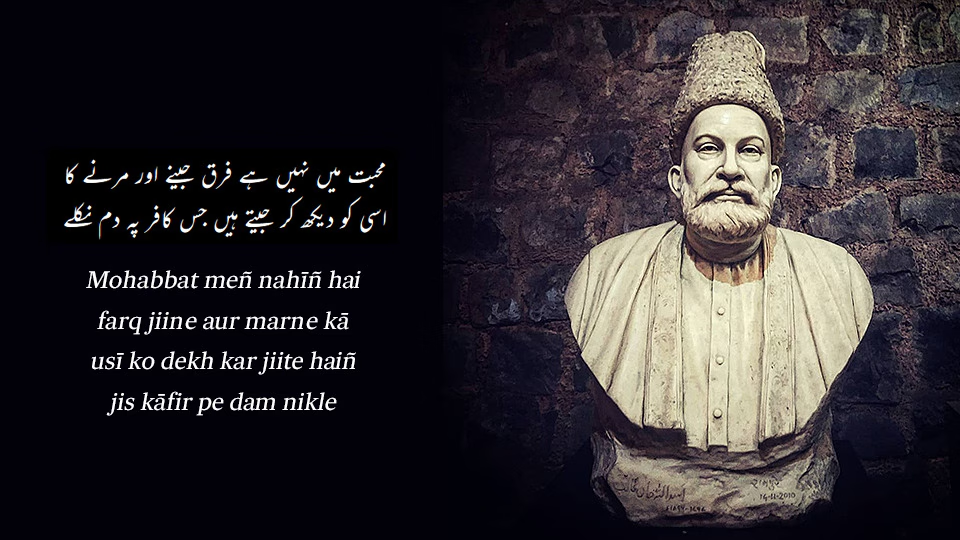
This is one reason Mirza Ghalib Poetry still feels fresh today. A reader may smile at a verse first and then realize that there is a much deeper pain hidden behind that smile. Ghalib could turn an ordinary situation into a complicated emotional and philosophical experience. His poetry is also known for creating multiple meanings through metaphor and unusual combinations of familiar ideas.
In this article, we will explore seven interesting moments where Mirza Ghalib Poetry uses humor or irony to express pain, disappointment, love, loneliness, and the strange difficulties of life.
1. When Love Made Him “Useless”
One of the most memorable examples of Ghalib’s playful approach to love is:
عشق نے غالبؔ نکما کر دیا
ورنہ ہم بھی آدمی تھے کام کے
Ishq ne ‘Ghalib’ nikamma kar diya
Warna hum bhi aadmi the kaam ke
The simple meaning is humorous. Ghalib jokingly says that love has made him useless. Otherwise, he was once a useful man.
At first, this sounds like a light-hearted complaint .Mirza Ghalib Poetry However, there is real emotional pain underneath it. Love has changed his priorities and affected his ability to live normally. Instead of saying directly that love has disturbed his entire life, he turns the situation into a joke.
This technique makes the emotion more memorable. The reader smiles, but the smile carries sadness.
This is an important feature of Mirza Ghalib Poetry. He often makes emotional suffering sound like an intelligent joke. The pain is therefore not removed. Instead, it becomes easier to understand.
2. When Difficulties Became So Common That They Felt Easy
Another powerful example is:
رنج سے خوگر ہوا انساں تو مٹ جاتا ہے رنج
مشکلیں مجھ پر پڑیں اتنی کہ آساں ہو گئیں
Ranj se khugar hua insaan to mit jata hai ranj
Mushkilein mujh par padi itni ke aasaan ho gayin
Ghalib suggests that when a person becomes accustomed to pain, the pain itself can lose its power. He then adds the clever idea that he faced so many difficulties that difficulties eventually started feeling easy.
There is a strange humor in this thought.
Normally, more problems should make life harder. Ghalib reverses that expectation. His suffering has become so familiar that another problem does not seem particularly frightening anymore Mirza Ghalib Poetry.
Behind this clever statement is a serious observation about human nature. People can become accustomed to difficult circumstances. What once seemed unbearable can eventually become part of everyday life.
This makes Mirza Ghalib Poetry more than romantic poetry. It also explores resilience, human behavior, and the psychological effect of repeated suffering. Rekhta’s presentation of the couplet similarly interprets it as pain becoming less intense through repeated exposure.
3. When the Beloved Promises a Reunion on Judgment Day
Ghalib could even turn separation into sharp irony:
جاتے ہوئے کہتے ہو قیامت کو ملیں گے
کیا خوب قیامت کا ہے گویا کوئی دن اور
Jaate hue kehte ho qayamat ko milenge
Kya khoob qayamat ka hai goya koi din aur
The beloved says that they will meet again on the Day of Judgment. Instead of accepting this promise romantically, Ghalib responds with irony.
He basically suggests that if separation feels this painful, then perhaps Judgment Day is not some distant extraordinary event. For him, this moment already feels like one.
The humor is subtle. The poet takes a huge religious and cosmic idea and brings it into the emotional world of a lover.
This is one of the fascinating qualities of Mirza Ghalib Poetry. A simple conversation between lovers can suddenly become a comment on time, death, separation, and existence.
The reader may notice the cleverness first, but the deeper meaning is painful. The speaker does not want to wait. His present suffering is already too intense.
4. When Pain Does Not Need Medicine
Another memorable couplet says:
درد منت کشِ دوا نہ ہوا
میں نہ اچھا ہوا برا نہ ہوا
Dard minnat-kash-e-dawa na hua
Main na achchha hua bura na hua
The poet says that his pain did not become dependent on medicine, and he neither became better nor worse.
Mirza Ghalib Poetry The wording has an almost casual quality. It sounds as though Ghalib is discussing an ordinary health problem. Yet the emotional meaning is much darker.
The “pain” can be understood as emotional suffering. The poet is not celebrating recovery. Instead, he presents a state in which nothing really changes.
That creates a special kind of humor. Rather than dramatically announcing his sadness, he speaks about it almost casually.
This is why Mirza Ghalib Poetry can feel surprisingly modern. People often use humor in difficult situations because direct expressions of pain can become overwhelming. Ghalib turns that human habit into poetry.
5. When He Questions the Idea of Paradise
Ghalib’s humor could also become philosophical:
ہم کو معلوم ہے جنت کی حقیقت لیکن
دل کے خوش رکھنے کو غالبؔ یہ خیال اچھا ہے
Hum ko maloom hai jannat ki haqiqat lekin
Dil ke khush rakhne ko ‘Ghalib’ ye khayal achchha hai
The verse presents a playful but thought-provoking attitude toward the idea of Paradise.
The speaker says that he knows the reality of Paradise, but the thought is still useful for keeping the heart happy.
Mirza Ghalib Poetry The humor comes from the confidence of the statement. Ghalib does not present the thought as a simple religious declaration. Instead, he plays with the relationship between truth, belief, hope, and emotional comfort.
Underneath the wit is a serious philosophical question: do human beings sometimes need beautiful ideas simply because those ideas give them hope?
This kind of questioning makes Mirza Ghalib Poetry intellectually interesting. His poetry does not always give the reader an easy answer. Instead, it creates a question and allows the reader to think.
6. When Ghalib Turns Hypocrisy Into a Joke
Ghalib also used humor to comment on human behavior:
کہاں مے خانے کا دروازہ غالبؔ اور کہاں واعظ
پر اتنا جانتے ہیں کل وہ جاتا تھا کہ ہم نکلے
Kahan mai-khane ka darwaza ‘Ghalib’ aur kahan waiz
Par itna jaante hain kal wo jata tha ki hum nikle
The basic situation is amusing. A preacher is associated with morality, while a tavern represents the opposite world. Ghalib then points out that when he was leaving the tavern, the preacher was going inside.
The joke is obvious, but the criticism is deeper.
Ghalib does not simply say that people are hypocritical. He creates a small scene and allows the reader to discover the contradiction.
This is an important strength of Mirza Ghalib Poetry. His humor can reveal human weaknesses without requiring a long explanation.
The same couplet is discussed by Rekhta as an example of Ghalib’s use of wit and irony to expose the contrast between outward morality and private behavior.
7. When Waiting for Love Becomes Almost Absurd
Perhaps the most painful humor appears when Ghalib describes waiting:
ہم نے مانا کہ تغافل نہ کرو گے لیکن
خاک ہو جائیں گے ہم تم کو خبر ہونے تک
Hum ne mana ke taghaful na karoge lekin
Khak ho jayenge hum tum ko khabar hone tak
The speaker accepts that the beloved may eventually stop ignoring him. But there is one problem: by the time the beloved notices him, he may already have turned to dust.
This is a perfect example of emotional irony.
The speaker is technically hopeful. He believes that the beloved may eventually respond. Yet he immediately destroys that hope by pointing out that the response may arrive too late.
The humor comes from exaggeration, but the emotional truth is powerful. Waiting for someone who does not notice you can feel endless.
This is another reason Mirza Ghalib Poetry remains memorable. The poet takes an ordinary emotional experience and pushes it to an extreme point where it becomes both funny and painful. Rekhta’s explanation also highlights the couplet’s bitter irony and the idea that recognition may come only after irreversible loss.
Why Ghalib’s Humor Makes His Pain More Powerful
The unusual thing about Ghalib is that humor does not weaken his sadness. Instead, it often makes the sadness stronger.
A direct statement such as “I am suffering” may be emotionally clear, but it can also be predictable. Ghalib approaches suffering from another direction. He adds a joke, a contradiction, a surprising comparison, or an intellectual twist.
As a result, the reader participates in discovering the pain.
This technique can be seen across Mirza Ghalib Poetry. His famous ghazals contain themes of love, longing, loss, hope, disappointment, and philosophical uncertainty. Rekhta’s collection includes hundreds of his ghazals and lists many widely read examples, including “Hazaron Khwahishen Aisi,” “Koi Ummeed Bar Nahin Aati,” and “Dil-e-Nadan Tujhe Hua Kya Hai.”
Ghalib’s imagination is also central to his poetic style. Literary analysis of his work emphasizes how he could take familiar ideas and rearrange them into surprising new meanings.
The Modern Appeal of Mirza Ghalib Poetry
Even today, people can relate to Ghalib because his emotional situations are surprisingly familiar.
People still experience unreturned love. They still wait for messages that never arrive. They still use jokes to hide disappointment. They still question life, hope, relationships, and human behavior.
That is why Mirza Ghalib Poetry can be shared on social media, discussed in classrooms, quoted in conversations, and read for personal comfort.
His poetry does not require every reader to have the same experience. A couplet can mean one thing to a young person and something completely different to someone who has lived through loss, loneliness, or heartbreak.
That openness is part of Ghalib’s lasting appeal.
Conclusion
Mirza Ghalib had a rare ability to make the reader smile while quietly revealing something painful underneath. His humor was not simply entertainment. It was often a poetic method for discussing love, failure, loneliness, hypocrisy, uncertainty, and the strange difficulties of human life.
The seven examples above show how Mirza Ghalib Poetry can move between humor and sadness within only a few words. A joke can hide heartbreak. A clever statement can contain philosophy. A romantic promise can become an observation about time and death.
Perhaps that is why Ghalib’s poetry continues to feel alive. His verses do not simply tell us that life is painful. They show us that sometimes the best way to face that pain is to understand it, question it, and even laugh at it.
Mirza Ghalib Poetry therefore remains more than a collection of beautiful verses. It is a conversation about the human heart—sometimes serious, sometimes romantic, sometimes philosophical, and sometimes wonderfully funny.